Compartir:

On the evening of 12 August 2026, the Moon will slip between the Earth and the Sun, and for a narrow band of people across Iceland and northern Spain, the sky will briefly turn dark in the middle of summer. It will be the first total solar eclipse visible from mainland Europe since 1999 — and the geometry that makes it happen is genuinely unusual.
This is not just another eclipse. The combination of timing, location, and astronomical geometry makes the 2026 event one of the most anticipated sky events in a generation. Here is everything you need to know — including how to use Shadowmap to scout your viewing spot before the crowds arrive.
What Is Actually Happening on 12 August 2026
A total solar eclipse occurs when the Moon moves precisely between the Earth and the Sun, completely blocking the solar disc. The result is a few minutes of daytime darkness, a sudden drop in temperature, confused birds, and — for those in the right spot — a view of the Sun's corona: the delicate, wispy outer atmosphere that is normally drowned out by the Sun's brightness.
The shadow of the Moon traces a narrow path across the Earth's surface called the path of totality. Only those inside this path see a total eclipse. Everyone outside it sees a partial eclipse, where the Moon takes a "bite" out of the Sun but never covers it completely. According to NASA, the difference between totality and a 99% partial eclipse is not small — it is the difference between an ordinary afternoon and witnessing something that feels genuinely surreal.
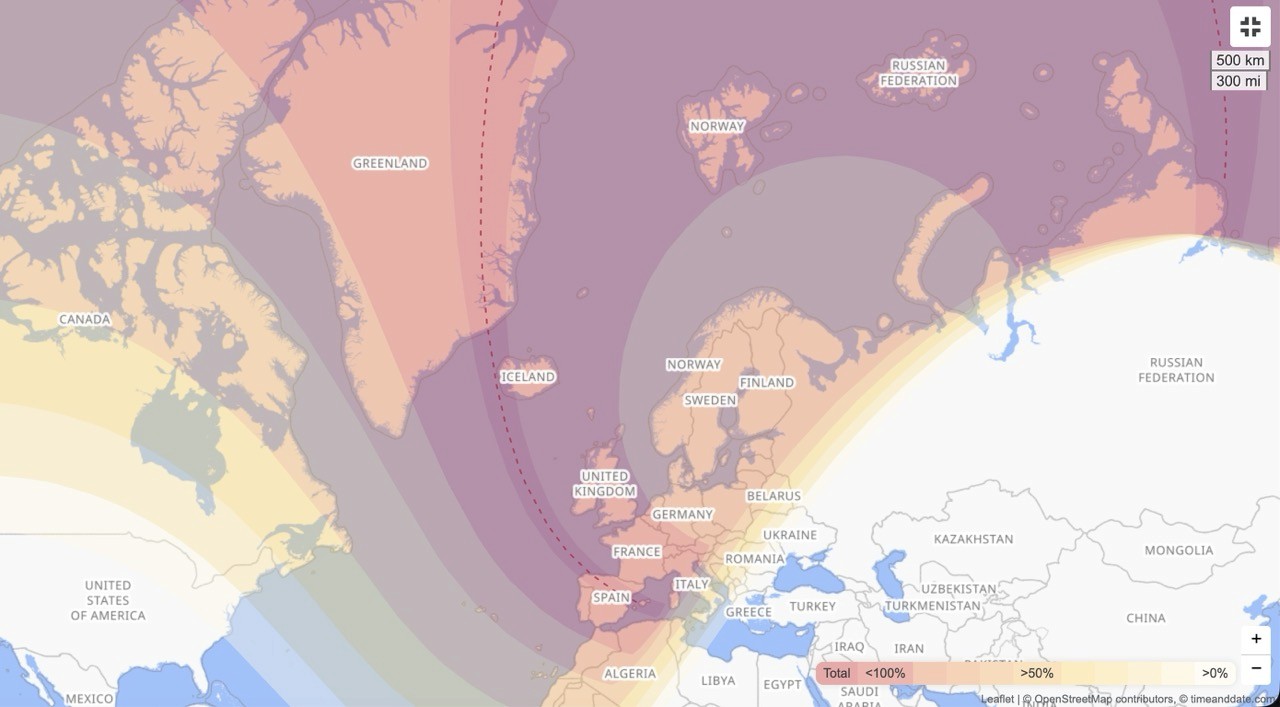
The 2026 path of totality begins in remote Arctic Russia, sweeps down through the North Atlantic, crosses Iceland, and then cuts diagonally across the entire Iberian Peninsula from the Galician coast to the Balearic Islands, as mapped by the National Solar Observatory. You can also check the interactive map on timeanddate.com (as seen above).
Why This Eclipse Is Different
Most total solar eclipses that pass over populated areas happen with the Sun somewhere overhead. The 2026 eclipse does not. In Spain — the most accessible viewing destination for millions of Europeans — totality arrives just before sunset, when the Sun sits only 2° to 10° above the western horizon, according to astronomers at Star Walk.
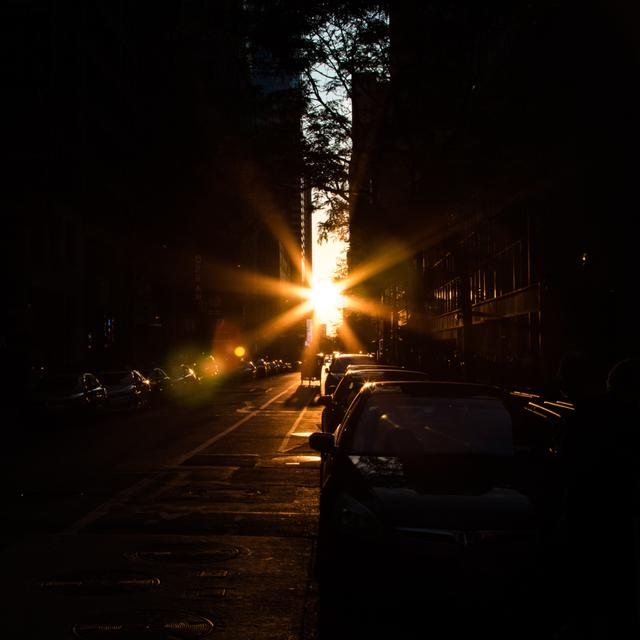
This creates something rare: a "golden hour" eclipse. The solar corona, which is already one of the most beautiful things visible in the natural world, will appear framed against the warm light of a Spanish summer evening, hanging low and vast over the horizon. It has the visual quality of a scene from a film — and it is real.
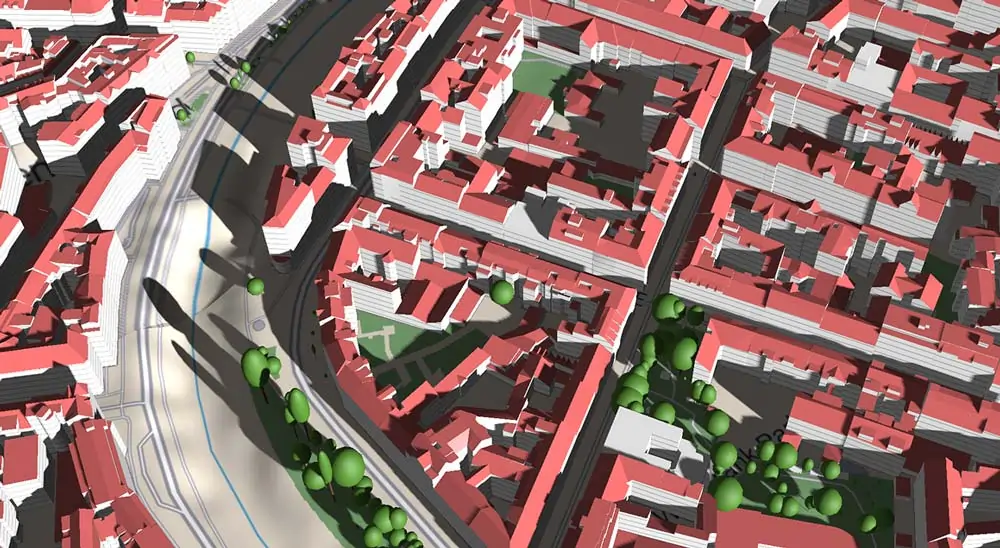
The flip side is that a low Sun means horizon obstructions matter enormously. A hill, a row of apartment buildings, or even a dense tree line to the west can block the view entirely. This is not a sit-in-the-park-and-look-up event. Finding your specific viewing location in advance is essential.
There is one more reason the 2026 eclipse is special. On the same evening, the Perseid Meteor Shower is near its peak. During the brief minutes of totality, the sky will darken enough that observers may catch meteors streaking across the corona. According to EarthSky, this blockbuster night for astronomers gets even better: the day begins with a six-planet alignment before sunrise.
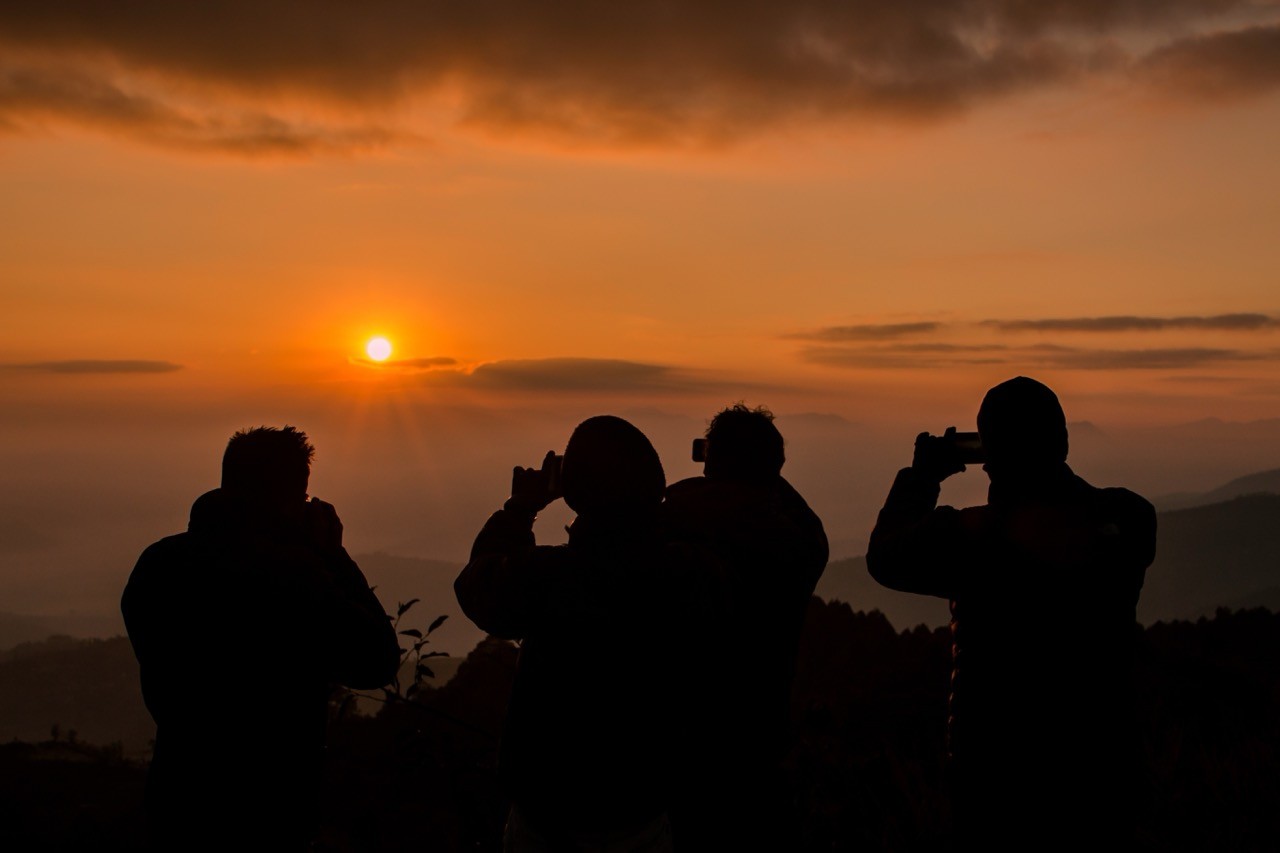
Where to Watch: The Path of Totality
The path of totality in Spain enters from the northwest coast of Galicia at around 20:27 local time and sweeps east-southeast, reaching the Balearic Islands just after 20:31. According to detailed local timing data from Idealista, totality lasts between about 30 seconds and just under two minutes depending on location, with the longer durations available closer to the centreline of the path.
Key cities inside the path of totality include A Coruña, Oviedo, Santander, Bilbao, León, Burgos, Zaragoza, Valencia, and Palma de Mallorca, as documented by BBC Sky at Night Magazine.
Madrid and Barcelona will see a partial eclipse of around 99% — dramatic on paper, but with no corona, no darkening sky, and no temperature drop. Many millions of people in those cities are expected to travel north into the path of totality on the day.
Weather considerations matter as much as location. The Atlantic coast — Bilbao, Santander, A Coruña — has an average August cloud cover of around 60% and carries real risk of obscured skies, according to eclipse meteorology analysis from Solar Eclipse Spain. The best weather odds are in the Ebro River valley around Zaragoza and Huesca, where cloud cover in August historically drops below 30%. Burgos, on the flat open plains of Castile and León, is another strong choice with good sightlines and better-than-average sunshine statistics.
Iceland offers an alternative for those who want the Sun higher in the sky and are willing to trade Spanish sunshine odds for dramatic Nordic landscapes. And as the Royal Observatory Greenwich notes, this will be the most coverage seen from the UK and Ireland since the 1999 total eclipse.
The Critical Challenge: Finding an Unobstructed Western Horizon
Because the Sun will be so low at the moment of totality, the single most important factor in choosing your spot is a clear, flat view to the west. This is where most casual observers will make mistakes — and where planning ahead makes all the difference.
Urban settings are particularly tricky. Even a modest building or a hillside ridge to the west can completely block the eclipsed Sun. In a city like Zaragoza, the historic bridge across the Ebro with the Basílica del Pilar behind you offers a famous unobstructed western view. On the Galician coast, elevated cliff viewpoints and beaches with open Atlantic horizons give you the flat sightline you need. In Mallorca, coastal promontories and boat-based viewing offer similar advantages. As Euronews notes, Spain is the second-most mountainous country in Europe — a wide, flat horizon is genuinely harder to find than it looks on a map.
The challenge is that the ideal spot for one person — an open hillside, a rooftop terrace, a stretch of beach — will be obvious to thousands of others. Scouting your location in advance, and arriving early, is not optional. It is the whole game.
How to Use Shadowmap to Scout Your Eclipse Viewing Location
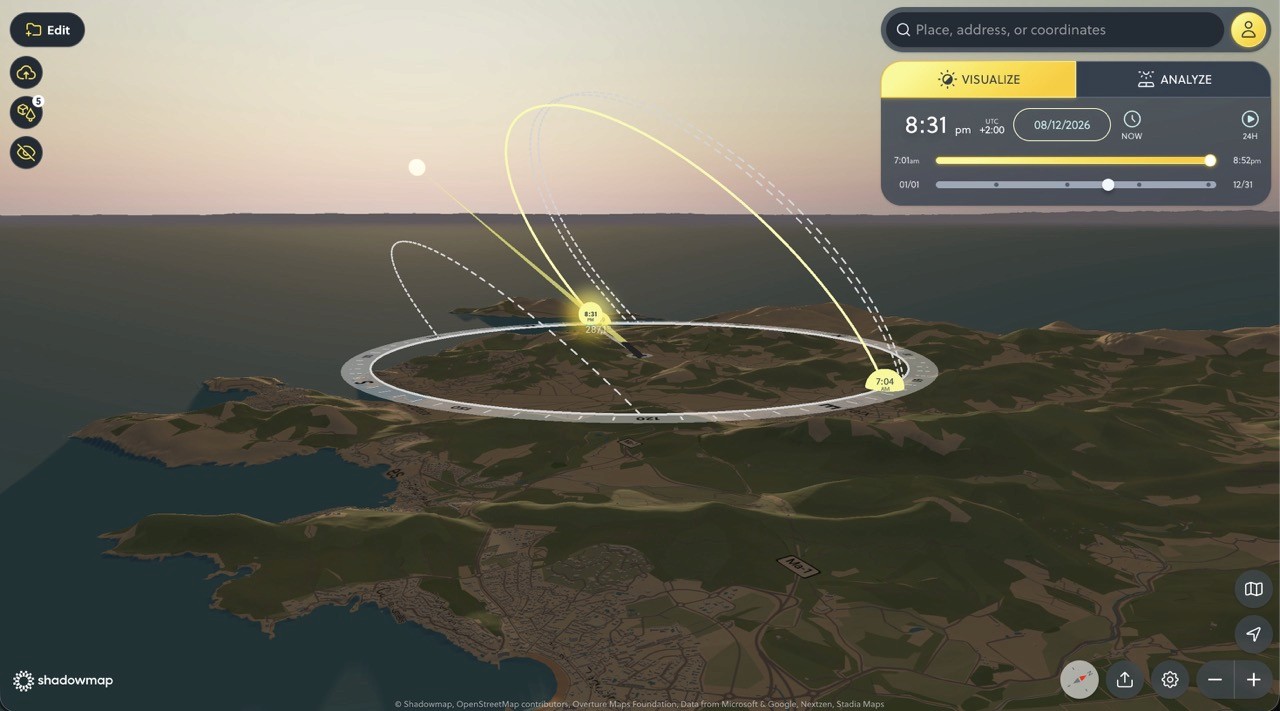
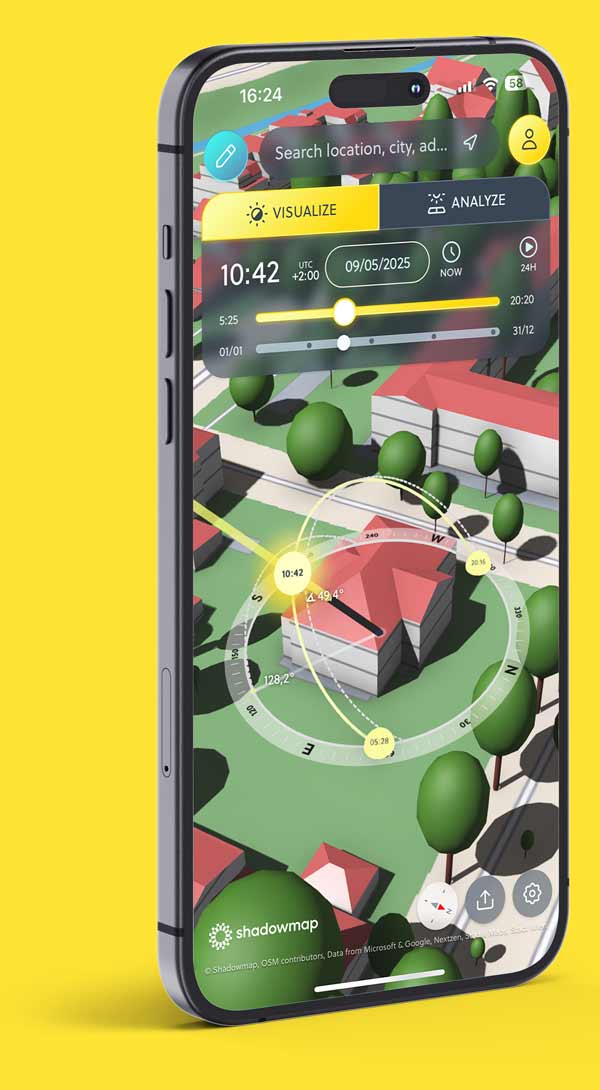
This is where 3D sun simulation becomes genuinely useful. Shadowmap lets you set any location on Earth to any date and time, and see exactly how the Sun sits in the sky — including what buildings, terrain, and structures might block the view.
For eclipse planning, here is how to use it:
Set the date to 12 August 2026 and the time to around 20:28–20:32 local time (depending on where in Spain you are checking). The Sun will be in the west at a very low angle. You can immediately see:
Whether any building, ridge, or hillside to the west blocks the Sun at that exact elevation
How the shadow from nearby structures falls at that specific moment
Whether an elevated viewpoint — a park on a hill, a rooftop terrace, a cliff — clears the obstructions at street level
Try multiple candidate spots and compare them. The difference between two locations 200 metres apart can be significant when the Sun is only 5° above the horizon. A spot that looks open on a map might have a four-story building precisely in the line of sight at 20:30. Shadowmap lets you check that in seconds, not on the day.
For those travelling specifically for the eclipse, this kind of location analysis is worth doing for two or three backup sites as well — in case cloud cover forces a last-minute decision.
Capturing the Eclipse: A Note from Astrophotographer Andrew McCarthy
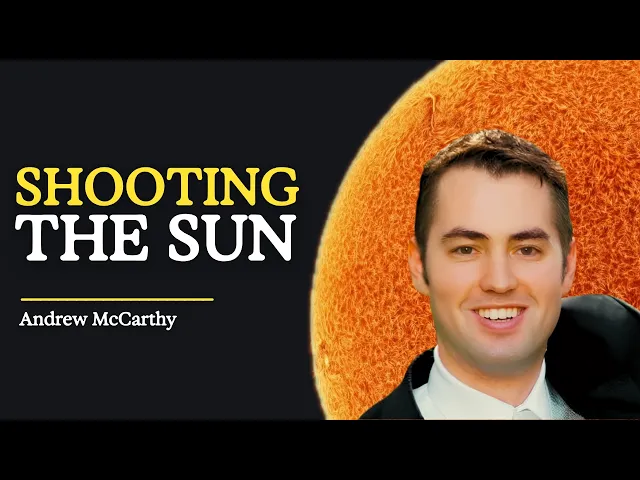
No one has thought more carefully about how to photograph the Sun than Andrew McCarthy, the Arizona-based astrophotographer whose hydrogen-alpha solar images — showing the Sun's chromosphere as a roiling ball of fire rather than a flat disc — have reached millions of people worldwide. Andrew joined us on the Sunlight Matters podcast to talk about his work, and when the 2026 eclipse came up, his answer was revealing: he plans to document it from a boat, keeping his options open based on where the weather is clear. Flexibility, he said, matters more than committing to a fixed location when the Sun will be this low and cloud risk this variable.
Andrew's practical tip for photographing the Sun near the horizon applies directly to eclipse day: when the Sun is low, the atmosphere acts as a natural ND filter, which lets you stop down your lens and capture a crisp disc. During the brief moments of totality — when the Moon completely covers the Sun — the corona is visible and safe to photograph directly. Everything changes in those two minutes.
For live expert guidance to prepare for the eclipse you can also join astronomer Dr John Mason on July 29 for a free online event.
A Note on Eye Safety
One thing that makes this eclipse unusually forgiving and spectacular: the Sun will already be very low on the horizon, meaning the atmosphere absorbs much of its intensity naturally — the same effect that makes sunsets comfortable to look at with the naked eye.
If you want to be absolutely safe while you observe the partial phases for an extended time, or point a camera or binoculars at the Sun before totality, certified ISO 12312-2 eclipse glasses are a sensible precaution.
Key Takeaways
The 12 August 2026 total solar eclipse is the first visible from mainland Europe since 1999, making it a once-in-a-generation event for Spanish and European observers
In Spain, totality arrives at golden hour — just before sunset — with the Sun only 2–10° above the western horizon, creating a uniquely dramatic but technically demanding viewing scenario
The best weather odds are in the Ebro Valley around Zaragoza; Atlantic coast cities carry significantly higher cloud risk
Because the Sun is so low, a clear unobstructed western horizon is the single most important factor in choosing your viewing spot — more important than being in the exact centre of the path
Use Shadowmap to check candidate viewing locations for building and terrain obstruction at the exact time and date of totality before you travel
For extended viewing of partial phases, ISO 12312-2 eclipse glasses are a sensible optional precaution; totality itself is safe to watch with the naked eye
Compartilhar este artigo:
SAIBA MAIS
Visões esclarecedoras


Como visto em