Compartir:

In permaculture, you don't start with plants. You start with observation.
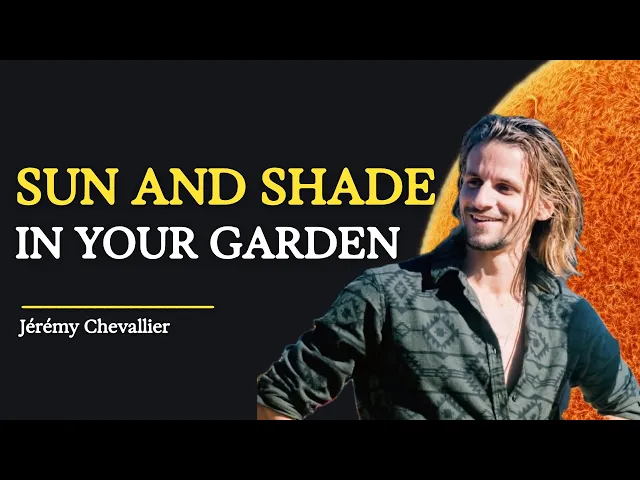
That's the principle that guides Jérémy Chevallier, a permaculture designer and founder of Permascaping in Phoenix, Arizona — one of the hottest, driest cities in the United States. When he joined Dave on the Sunlight Matters podcast, the conversation quickly became a masterclass in how light, shadow, soil, and water interconnect — and how Shadowmap has become a central tool in the way he plans and teaches permaculture design.
Want to see how the sun moves across your own garden? Open Shadowmap for free, find your home and scrub through any day of the year. It’s the same first step Jérémy takes with every client, and you’ll find more ideas in Shadowmap for Gardeners.
Observe First, Plant Later
Permaculture begins with what's already there. Before Jérémy recommends a single plant species, he studies how the sun moves across a property across the year — where it bakes in summer, where it barely reaches in winter, and how walls, buildings, and existing trees shape the micro-environment of a yard.
"Start by observing what's already going on on your property," he explains. "What's growing, what's struggling, where it stays moist, where it dries out immediately." In a Phoenix yard, that might mean noticing a patch of moss growing on the north side of the house near an air conditioning condensate line — a clue that the soil there stays cool and damp — while just about 10 meters (30 feet) away the soil is almost impossible to keep alive.
This principle applies far beyond the desert. Anywhere you garden, sunlight and shade are the invisible architecture of your space. Most people assess their gardens by standing in them on a sunny afternoon. But that single snapshot is misleading: the sun's path shifts dramatically between summer and winter, shadows from buildings lengthen significantly as the year turns, and a space that looks sun-drenched in July may be in near-constant shade by October.
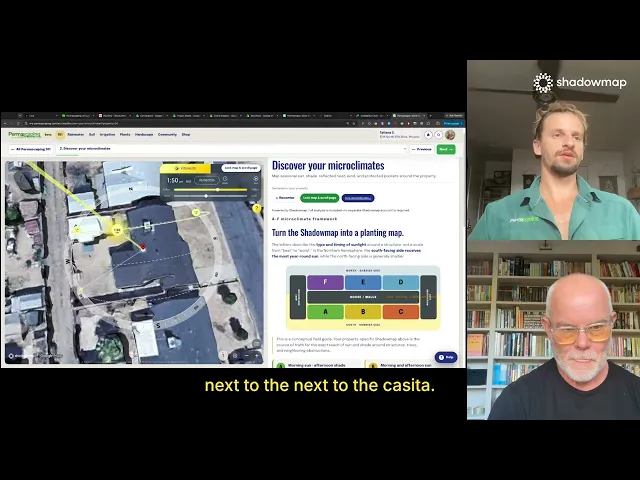
This is exactly the problem that Shadowmap was built to solve — and the reason Jérémy has integrated it directly into the Permascaping app.
The A–F Microclimate System
One of the most practical things Jérémy has built into Permascaping is a microclimate classification system that divides any property into zones based on how much sun they receive throughout the year — and Shadowmap is the engine that visualizes it.
A microclimate — east-facing or sheltered from afternoon sun by a wall or building — gets morning sun and afternoon shade. In a Phoenix summer, this is prime growing territory for many food plants. B microclimate — full exposure from morning through afternoon — is the most challenging in a hot desert, though well suited to heat-loving desert natives and drought-adapted groundcovers. C microclimate — west or southwest facing — gets the intense afternoon sun but misses the gentler morning light.
Moving to the shadier north-facing areas of a property, D, E, and F microclimates describe areas with progressively less sun — partial afternoon shade, filtered or reflected light, or deep shade throughout the day.
By pulling up Shadowmap inside the Permascaping app and sliding through the hours of a summer day versus a winter day, Jérémy can show clients in seconds what took experienced designers years of on-site intuition to learn. At midday in high summer, the sun stands roughly 77 to 80 degrees above the horizon in Phoenix, rising in the northeast and setting in the northwest, so most of a property is bathed in light. Move the slider to winter and the sun drops low in the southern sky: shadows stretch out to the north, and the north side of every wall, house and tree becomes a very different world.
Why Sun Angles Change Everything
One detail that surprises many people, even experienced gardeners: the dramatic seasonal swing in where the sun rises and sets. In Phoenix, as in the UK, the sun rises in the northeast in summer and in the southeast in winter. The arc it travels across the sky is completely different. What this means in practice is that a tree, wall, or fence that barely casts a shadow in June can plunge an entire bed into shade for most of the day in December.
Dave mentioned this from personal experience watching his neighbors' mature Scots pine trees grow — over a hundred years, their branches have all reached toward the sun, making the trees structurally lopsided and potentially dangerous. A shadow analysis at the time of planting could have shown how much light they would be competing for as they grew.
For Jérémy, this is why planning for mature canopy size is as important as planning for today's conditions. "I review landscaping plans from developers all the time that show a Chilean hybrid mesquite tree with a 10-foot circle in the front yard," he says. "That tree is going to be 40 to 50 feet wide at maturity." Being able to model the full-grown shadow of a tree that currently doesn't exist — using Shadowmap's Studio features — is exactly the kind of forward planning that separates a well-designed landscape from one that creates problems for decades.
What the Permascaping App Does — and How Shadowmap Powers It
The Permascaping app is currently free for anyone to sign up and is focused primarily on the Phoenix and southern Arizona area, though Jérémy's goal is to expand it as a tool for urban food forest planning anywhere. At its core, it combines the microclimate classification system above with Shadowmap's 3D sun and shadow simulation, letting users see how sun moves across their specific property at any time of day and any point in the year.
One feature Jérémy is eager to add next: the ability for users to place their own trees in the 3D model — including at mature canopy size — to see exactly what shade they'll create across different seasons before a single plant goes in the ground. This is precisely what Shadowmap Studio already enables, and the integration is the natural next step.
"I do this sort of modeling in 3D design software now," Jérémy explains, "but what I don't like about those tools is that you just control the sun's position through coordinates. I don't want to figure out what degree the sun is at. I just want to say: let's look at it at the fall equinox at midday. That's what Shadowmap gives you."
Layers: How a Food Forest Actually Works

Once the microclimate map is in place, Jérémy begins designing what permaculturists call a food forest — a multi-layered planting system that mimics the structure of a natural woodland, but with edible and useful plants at every level.
The layers work from the ground up:
Upper canopy trees — fast-growing, drought-tolerant shade providers like mulberry (exceptional in Phoenix — dense canopy, grows fast, extremely water efficient), native mesquite, ironwood, and Palo Verde
Mid canopy — figs, pomegranates, jujube trees; the jujube is particularly useful because its filtered canopy lets light through to lower layers
Lower canopy and understory — fruiting shrubs, herbs, shade-tolerant edibles
Ground cover — living mulches, spreading plants, anything that keeps soil covered and active
Climbing and vining layer — grapes, passionfruit, and other vines grown over trellises and shade structures
Root and underground layer — potatoes, peanuts, and root vegetables, alongside the mycorrhizal fungal networks that connect and feed everything above
The logic behind establishing canopy trees first — especially drought-hardy pioneer species — is that they create the microclimate conditions that make everything else possible. "We want to establish these microclimates as quickly as possible using the most drought-tolerant, sun-hardy species we can," Jérémy says. "Once you have that shade, you can start introducing more sensitive species underneath."
Shade as a Tool: Using It Deliberately

One of the more counterintuitive lessons from the conversation is that shade is not just a limitation to work around — it's an active design tool.
Jérémy gives the example of Bermuda grass, a common and persistent weed in Phoenix yards. Most people try to remove it mechanically or chemically. His preferred approach in certain situations: plant a dense upper canopy, like ficus trees, and simply shade it out. "Bermuda grass needs at least six hours of direct sun to grow thick. Starve it of light and it dies." On his route to the grocery store, he passes a flood-irrigated property where two large ficus trees have eliminated all Bermuda grass from the front yard without any chemical intervention.
Conversely, he learned from direct experience that not enough sun kills productivity just as surely as too much shade. He planted tomatoes, peppers, and squash under a peach tree — and the only plant that thrived was the squash at the north end of the bed, which got just a couple of hours of midday shade but was otherwise in full sun morning and afternoon. The plants further south, in more shade, barely grew.
This is exactly what Shadowmap's irradiance analysis shows: not just where shadows fall, but how many hours of direct sun a specific patch of ground receives across the growing season — the number that actually determines whether your food plants will succeed.
Rainwater, Soil, and the Bigger Picture

Jérémy's thinking extends beyond individual plants to the systems that support them — particularly water and soil.
In Phoenix, the city averages just seven to eight inches (about 180 to 200 mm) of rain per year. His approach to making that work is rainwater harvesting: routing rooftop runoff through gutters and downspouts into retention basins positioned around fruit trees. The math is straightforward and compelling. For every 1,000 square feet (93 m²) of roof in a one-inch (25 mm) rain event, you capture 623 gallons (about 2,360 liters). If you direct that water into a 200-square-foot (19 m²) basin, you've effectively created a five-inch (127 mm) rainfall event in that spot. In a desert, that's the difference between a tree that struggles and one that thrives.
He draws inspiration from Brad Lancaster, the Tucson-based author and activist who pioneered desert rainwater harvesting at a neighborhood scale — cutting curbs and routing stormwater from streets into planted basins, transforming entire city blocks.
Beneath all of this is what Jérémy describes as the foundational principle that drew him to permaculture in the first place: soil health. "We've lost 30 to 50 percent of our topsoil globally to conventional farming and tilling," he says, citing the Save Soil movement championed by Sadhguru. "The proverb in permaculture is: we don't grow plants. We grow the soil, and the soil grows the plants."
Trees contribute to soil health not just through leaf litter and root activity, but through transpiration — releasing water through their leaves in a far more stable form than bare-soil evaporation. Dense plantings of trees cool the air, stabilize humidity, and build the conditions for everything else to grow.
How to Use Shadowmap for Permaculture Planning
Whether you're approaching your garden through a permaculture lens or simply want to grow more food in the space you have, the process Jérémy describes translates directly into a Shadowmap workflow:
1. Map your microclimates. Open Shadowmap and navigate to your property. Set the date to the summer solstice (June 21) and scrub through the hours of the day. Note which areas are in shade and when. Then do the same for the winter solstice (December 21) — the results will often surprise you.
2. Identify your A, B, and C zones. East-facing areas with afternoon shade, full-sun south-facing areas, and west-facing areas with afternoon sun create very different growing conditions. Knowing which you have tells you which plants to use where.
3. Model your trees at maturity. Using Shadowmap Studio, place trees at the size they'll reach in ten or twenty years, not just how they look today. See what shade they'll cast on your vegetable beds before you plant them.
4. Scout your best growing windows. Use the irradiance analysis to find which areas of your garden accumulate the most total sun across the growing season. Those are your premium spots for fruiting vegetables and sun-hungry herbs.
5. Plan your shade structures deliberately. If you want to grow vines over a pergola, or use trellises to cool a west-facing wall, place them in Shadowmap first to see what they'll shade — and what they'll protect.
Key Takeaways
Permaculture design starts with observation, not plants — understanding how sun and shadow move across your space across all seasons is the foundation of any successful garden
The A–F microclimate system in the Permascaping app classifies every area of a property by its sun exposure, and uses Shadowmap to visualize it
Shade is an active tool, not just a problem: it can eliminate weeds, cool surfaces, and create the protected microclimates that let sensitive plants thrive underneath
Planning for mature canopy size — not just how trees look today — prevents decades of problems and is possible with 3D shadow modeling
Rainwater harvesting and soil health are inseparable from sun planning: the same design thinking that optimizes light also optimizes water retention and soil biology
The permaculture approach developed in extreme climates like Phoenix applies everywhere water is increasingly scarce — including much of Europe
Frequently Asked Questions
What is permaculture design?
Permaculture is a way of designing gardens and landscapes that works with natural patterns instead of against them. It starts with careful observation of sun, shade, water and soil, and then places each plant where those conditions suit it best, so the system needs less water, fewer inputs and less maintenance over time.
What is a food forest?
A food forest is a multi-layered planting that mimics a natural woodland, with edible and useful plants at every level: canopy trees, smaller fruit trees, shrubs, herbs, ground cover, vines and root crops. Taller layers create shade and shelter that make it possible to grow more sensitive plants underneath.
How many hours of sun do vegetables need?
As a general rule, fruiting vegetables such as tomatoes, peppers and squash need at least six to eight hours of direct sun a day, while leafy greens and many herbs cope with less. In very hot climates like Phoenix, some afternoon shade can be just as important as morning sun. Make sure to check the needs of your plants beforehand.
How can I find out how much sun my garden gets?
Open Shadowmap, find your property and move through the hours of the day for the summer and winter solstice. Shadowmap Studio and its irradiance analysis show how many hours of direct sun each part of your garden receives across the year, and let you add trees or structures before you build or plant them. With Shadowmap Explorer you can already unlock the full year for planning.
Does this approach only work in hot, dry climates?
No. The same principles apply anywhere. In hot climates the goal is often to create shade and protect plants from the afternoon sun; in cooler, cloudier climates it is usually to find and protect the sunniest spots. In both cases, understanding how light changes through the seasons is the first step.
Compartilhar este artigo:
Continuar a ler
Mais sobre Outdoors & Lifestyle



Do blog
Artigos mais recentes




Como visto em