Partager:
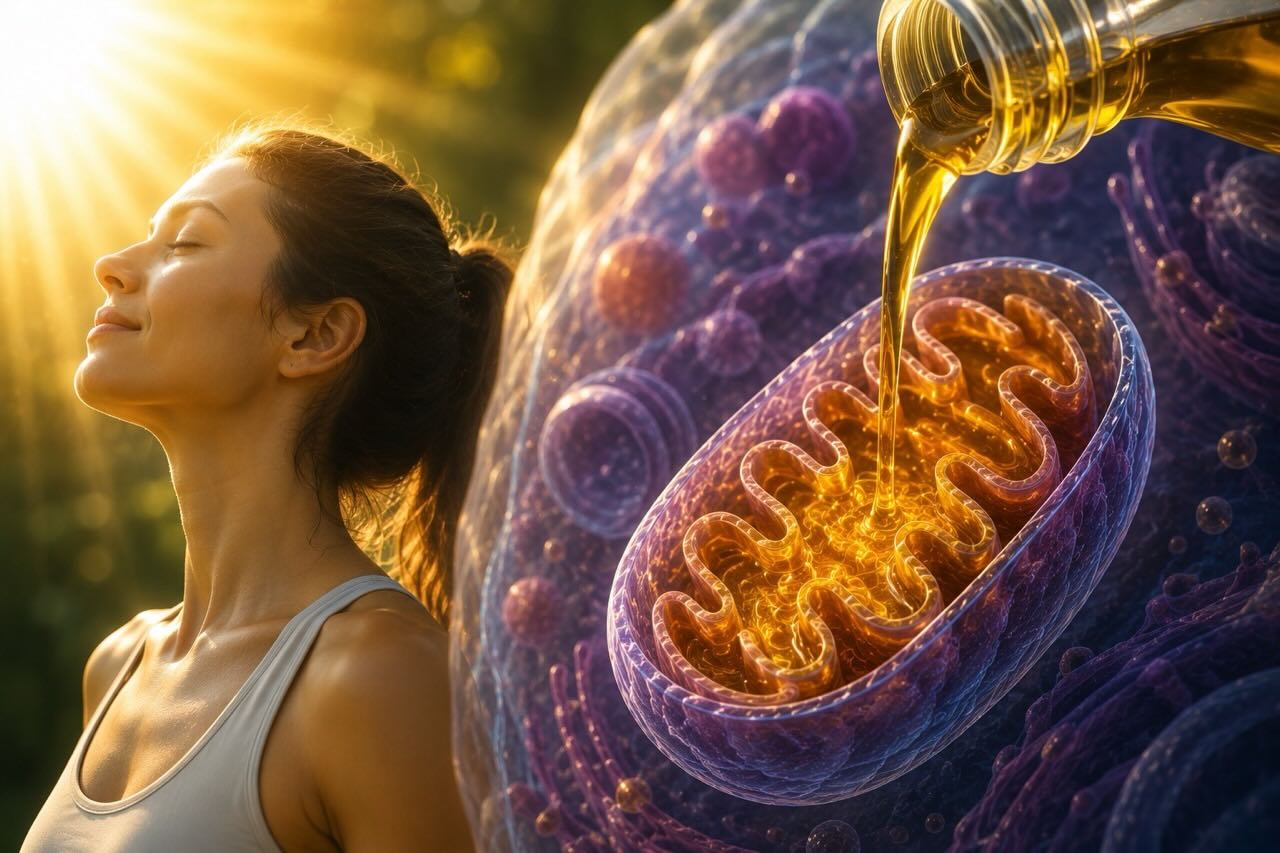
A new scientific paper proposes something startling: that daylight doesn’t just brighten our rooms, it physically services the engines inside our cells. Here is the idea, in plain English — told through the everyday pictures the scientists themselves reached for.
Think of the last time you stepped out of a dim building into bright sunshine and felt, almost instantly, a little better. We tend to file that feeling under “mood” — pleasant, but not serious. A growing group of scientists think we have badly underestimated what is actually happening. Their argument, set out in a new paper, is that sunlight is not a luxury for the human body. It is maintenance. It is, quite literally, the oil that keeps our engines running cleanly.
To understand why, you have to look inside your own cells — and the best way in is through a series of homely pictures: a Rolls-Royce, a canal full of locks, a toy steam engine, and a cork bobbing on a pond. None of these is a gimmick. Each one captures a real piece of the science.
The Rolls-Royce you have to keep for life
Imagine you turn twenty and a wealthy relative hands you a Rolls-Royce — with one condition. It has to last you the rest of your life. There will be no replacement. From that day, your job is maintenance: the right fuel, regular servicing, a little care, year after year.

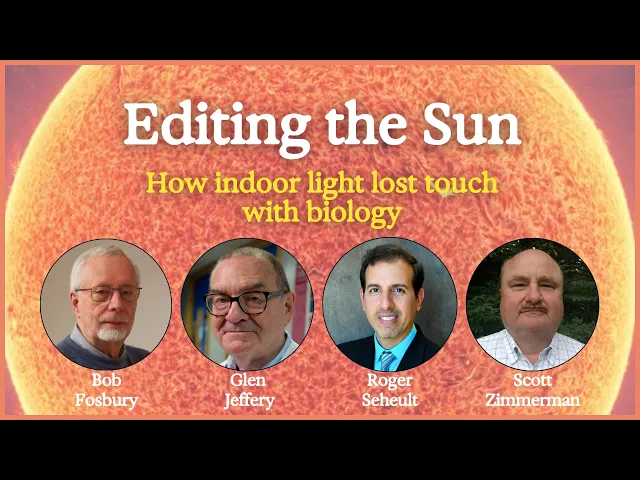
Your body is that car. By around the age of twenty, you have finished growing. From then on, as astrophysicist Bob Fosbury puts it, the work of living is mostly about upkeep — holding yourself together against the natural tendency of things to fall apart. The physicist Erwin Schrödinger noticed this back in 1944: the main reason we eat is not to make energy so much as to maintain the exquisite order inside us. Stop maintaining that order and, in Fosbury’s blunt phrase, you become “a blob of jelly dead on the floor.”
“We use sunlight to service our bodies — and to provide the oil that lubricates our engine and makes it work properly.”
— Bob Fosbury, astrophysicist
Here is the twist. We all know the car needs fuel — that’s food. But a car also needs oil. Food, the scientists argue, is our petrol. Sunlight is our oil. And crucially, the two do completely different jobs. The energy that powers you comes entirely from what you eat. Sunlight adds almost no energy to that. What it does instead is let the engine run smoothly, so it makes its power with less wear and tear. Fuel moves you. Oil keeps you from grinding yourself to pieces while you move.

The engines in every cell
The “engines” are real, and you have trillions of them. They are called mitochondria — tiny power plants packed into nearly every cell. Their job is to take the food you’ve eaten, broken down into a stream of electrons, and turn it into the usable energy your body spends on everything from thinking to healing. Jonathan Jarecki explained this process beautifully on our podcast before.
And just as a Rolls-Royce doesn’t use a single giant cylinder — which would shake itself apart — the mitochondrion doesn’t extract all the energy from an electron in one violent go. It does it gently, in a series of small steps. Which brings us to the prettiest picture in the whole theory.
A narrowboat going down a flight of locks
Picture a canal where the water steps down a hillside through a series of locks. A narrowboat descends one lock at a time — slowly, gently, under perfect control. At each step, the drop in height can be harnessed to do useful work.

That is exactly how your mitochondria handle an electron. The electron “runs downhill” through a chain, one controlled step at a time, and at each step the energy released is used to pump tiny particles (protons) across a barrier. Those protons then rush back through a microscopic turbine that mints the body’s universal energy currency. It is, as Fosbury says, “a beautifully complicated system” — and it is built to be gentle, because gentleness means less damage.
Why “gentle” is the whole point
Now imagine ripping out the locks and replacing them with a single steep chute. Send the narrowboat down that in one go and you get, in Fosbury’s words, “a crumpled mass at the end.” Inside a cell, that crumpling is real damage — and damage, accumulated over decades, is a large part of what we call ageing and chronic disease. The locks exist to make energy without wrecking the machinery that makes it.
Where the sunlight comes in
So where does daylight fit? Each of those barriers — each lock gate — takes a little effort for an electron to get over. Sunlight, the theory says, makes that crossing easier. It is the drop of oil on the piston.
Fosbury tells a story from childhood. His grandfather gave him a toy Meccano steam engine. He’d boil the water, build the pressure — and often nothing happened. The engine sat there, stuck. Then his father suggested a single drop of oil on the piston. “I put a drop of oil on the piston,” he recalls, “and suddenly it started and it was off.”
“The sunlight is making it possible for the electrons to get over these barriers more easily. It’s just like a lubricant.”
— Bob Fosbury
How can light act like oil? Here the last picture helps — a cork bobbing on a pond. Sunlight, especially the invisible near-infrared part we feel as gentle warmth, sets the watery environment inside our cells faintly vibrating, like a mild, constant earthquake. An electron waiting to cross a barrier is like a cork riding those ripples. Now and then a ripple lifts it high enough that the barrier in front looks small — and over it goes. The light never pushes the electron directly. It just keeps the water trembling, so the crossings happen more easily, all day long, for as long as the sun is on you.
A coincidence four billion years in the making
Here is the part that gives the scientists goosebumps. When you measure the energy an electron needs to clear those barriers — measured across plants, fungi, animals, life of every kind — it averages out to a very particular value. And when you measure the sunlight our particular star pours out most generously, after it has been filtered through the Sun’s own hazy atmosphere, its peak lands at almost exactly the same value.
The Sun’s favourite note and life’s favourite note are, near enough, the same note. To the researchers this is no accident at all, but the fingerprint of four billion years of evolution tuning living things to the light of the star they grew up under. There is even, they note, roughly as much of this infrared energy falling on your body as your body burns at rest — plenty to make a difference.
The headline, in one line
Sunlight doesn’t give you energy — your food does that. Sunlight helps you make that energy cleanly, with less damage. And less damage, repeated over a lifetime, may mean a longer, healthier one.
The scurvy of the 21st century
If sunlight is maintenance, the worrying corollary is what happens when we remove it — which is more or less what modern life has done. We spend our days indoors, behind glass that blocks infrared, under lighting chosen for efficiency rather than for biology.
Vision scientist Glen Jeffery describes a humbling discovery from his own lab. His experiments adding infrared light produced striking improvements in health and metabolism — but only, he realised, because his subjects were modern people and animals already starved of sunlight. “I’ve tried to reproduce sunlight in the lab,” he says, “and I can’t do it.” Mitochondria, it turns out, are exquisitely tuned to real daylight, and you cannot easily fool them with a clever bulb.
The shift happened quietly. Old incandescent bulbs, for all their inefficiency, were actually rather sun-like — rich in those long, warm infrared wavelengths. The LEDs that replaced them are, in Jeffery’s words, “incredibly unlike sunlight,” stripped of exactly the wavelengths that help our engines run. We changed the lighting of the entire indoor world, lighting expert Scott Zimmerman points out, without ever testing what it might do to our biology — and then made that new, narrower light the official standard.
“The baseline should be sunlight. Looked at that way, what we did made no sense whatsoever.”
— Scott Zimmerman, lighting scientist
This is not a Biohack
It would be easy to file all this under wellness trivia. The doctors involved are adamant it is the opposite. “This is not a biohack that’ll buy you an extra couple hundredths of a second in a hundred-metre dash,” says physician Roger Seheult. “This is a major, fundamental health issue.” At the heart of the West’s great chronic diseases — heart disease, diabetes, obesity — sits the mitochondrion. As Jeffery puts it, imagine running every appliance in your house on fifty percent less power. That is what poorly-served cells are trying to do.
And the real-world evidence is mounting. Seheult reels it off: large population studies in Sweden and the UK Biobank, the latter following some 300,000 people, finding that sun avoidance tracks with higher mortality from heart disease and cancer in a steady, dose-by-dose way. Blood tests that improve hour-for-hour with the previous week’s sunshine. Hospital trials where infrared light got intensive-care patients home a third faster, and stronger. Hospitals at King’s College and St George’s now taking ICU patients out into the sun; a new $1.5 billion hospital near Melbourne built around the same idea.
It is, Seheult notes, a rediscovery as much as a discovery. A century ago, before our modern instruments, doctors practised “heliotherapy” — healing with sunlight. Florence Nightingale could simply see that the patients nursed outdoors, because the wards were full, got better faster. We are now, slowly, working out why she was right.
The lime juice and the balanced diet
Seheult offers one last picture, and it reframes everything. Three hundred years ago, sailors on long voyages ate food stripped of vitamin C and developed scurvy. A daily ration of lime juice cured it — a near-miracle for a starving sailor, though useless to anyone already eating well.
Modern infrared therapies, he suggests, are the lime juice: a remedy for people deprived of something they should never have lost. But the lime juice was only ever a patch for a deeper problem. The real answer for those sailors was simply better food. And the real answer for us is not a gadget at all. It is the balanced diet of light we evolved under — the full, unfiltered spectrum of the Sun.
“Sunlight is getting a balanced diet on board the ship in the first place. That’s the best solution.”
— Roger Seheult, physician

Stepping back into the light
The scientists are careful to say this is a proposed explanation, not a closed case — the detailed physics is fiendish, and much work remains. But the thread running through all their everyday pictures is consistent, and quietly radical. Your body is a car you must keep for life. Its engines run on the food you eat — but they run cleanly, and last longer, only when they are oiled by the light of the Sun. We have spent a century moving indoors and engineering that light out of our days, without noticing the cost.
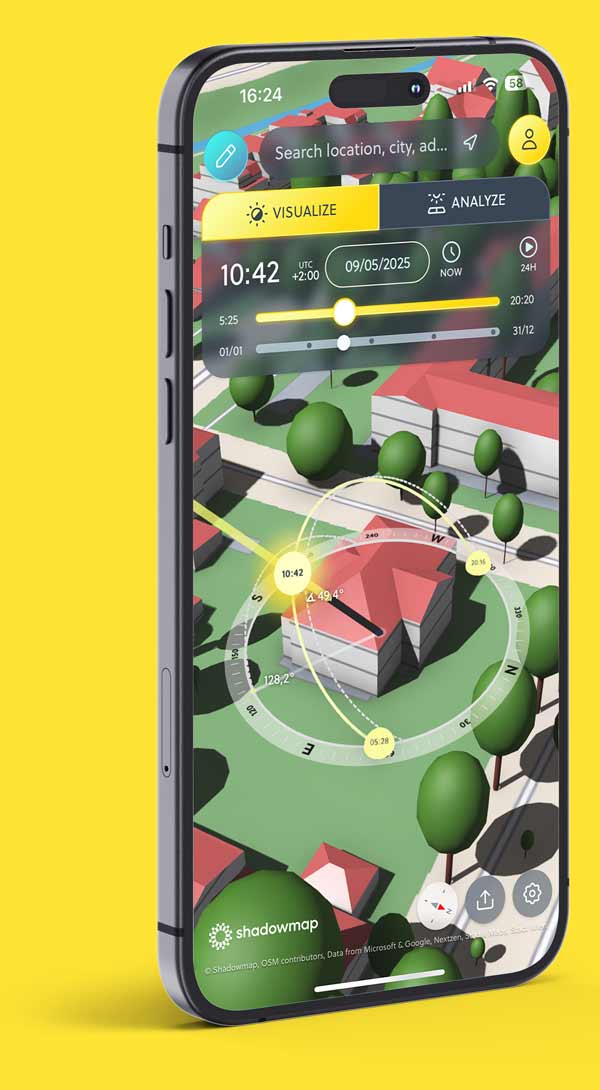
The good news is how simple the prescription is. Step outside. Let the daylight reach you. Think about how light moves through the places you live and work — which is, after all, why Shadowmap exists. The Sun has been servicing life on Earth for four billion years. It still offers the same standing appointment, free of charge, every single day.
Partager cet article:

EN SAVOIR PLUS
Des idées lumineuses



Tel que vu sur