Partager:

$4.6–4.7T | $179–291bn | +23% |
Total Annual Opportunity 4–5% of global GDP | Health Cost Savings Annually, conservative estimate | Solar Growth PV generation increase in 2024 |
Executive Summary
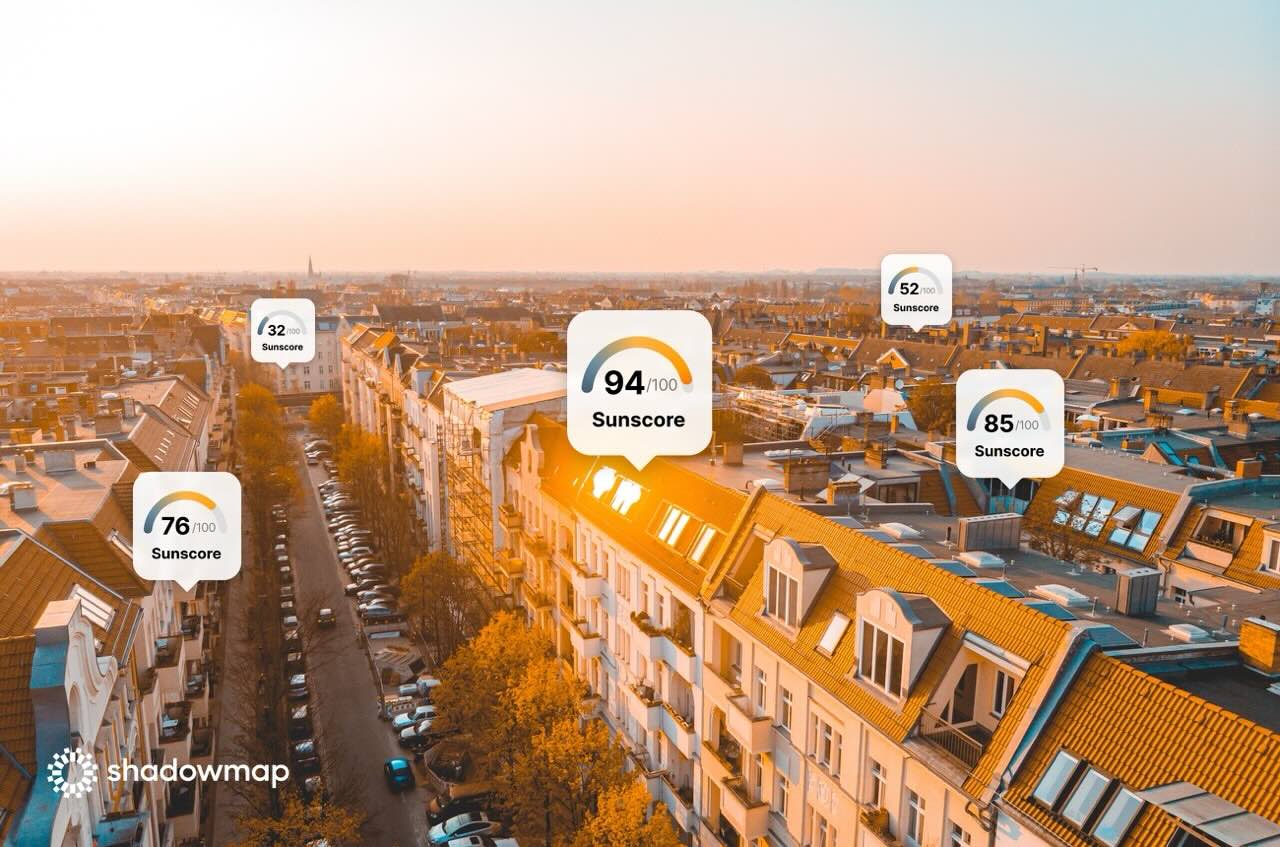
Shadowmap has launched Sunscore, the first metric for quantifying the economic value of sunlight. For the first time, the impact of the Sun on property values can be codified, compared, and priced.
Sunlight is not a lifestyle amenity. It is a material driver of asset value, public health outcomes, and energy economics. Sunscore makes that value legible to investors, developers, architects, insurers, and policymakers for the first time.
The total addressable opportunity, spanning solar energy, health cost reduction, and real estate value uplift, is estimated at $4.6-4.7 trillion annually, equivalent to 4–5% of global GDP.
The next step for Sunscore is to do the same for human health and energy generation, particularly at the residential level.
The Problem: Sunlight Has Never Been Properly Valued
Despite its enormous economic significance, the value of sunlight has historically been treated as unquantifiable — a qualitative preference rather than a measurable asset characteristic. This has created a systemic mispricing across three major markets:
Real estate: Sunlight access has lacked a standardised metric, making it impossible to price into property valuations with confidence.
Healthcare: The cost burden of sun-deprivation-linked disease is substantial but diffuse, and largely absent from policy frameworks.
Energy: Solar potential varies enormously by location, but granular sunlight data has not been widely integrated into asset underwriting or planning.
Sunscore addresses all three.

The Human Context: A World Moving Indoors
The business case for sunlight begins with a striking demographic fact: people in the developed world have become largely indoor creatures. The average person in the US and China now spends 90% of their life indoors; in the UAE, that figure exceeds 95%. As global temperatures rise, this trend is expected to accelerate.
This matters because sunlight is not merely pleasant; it is biologically essential. Every major organism on Earth evolved in response to light. Human physiology is calibrated to full-spectrum solar radiation, including wavelengths invisible to the naked eye. The emerging scientific consensus is clear: systematic sun avoidance carries serious health consequences.
Three physiological mechanisms are particularly well evidenced:
UV exposure triggers vitamin D synthesis and regulates circadian rhythm — both of which are foundational to metabolic and immune function.
Infrared light is critical to mitochondrial function. Growing evidence links its absence — compounded by the proliferation of LED-only environments — to a rise in metabolic disease.
Circadian disruption from inadequate natural light is now associated with increased risk of cancer, diabetes, cardiovascular disease, and cognitive decline.
The economic consequence is compounding. Ageing populations already represent a structural fiscal challenge for nation-states. Evidence that care home residents may receive only minutes of sunlight per month suggests that sun deprivation may be accelerating the very conditions — frailty, metabolic disease, cognitive decline — that drive care costs upward.
The Health Economics Case
Conservative modelling of three disease categories alone illustrates the scale of the opportunity:
Condition | Intervention | Estimated Annual Saving |
|---|---|---|
Myopia | 20–30% reduction in prevalence via increased outdoor time | $38–56bn (WHO, 2023) |
Cancer | 20–40% reduction in colorectal, breast & prostate cancer risk | $47–94bn (WHO, 2024) |
Type 2 Diabetes | 10–15% reduction in prevalence | $94–141bn (IDF, 2024) |
Combined | Conservative aggregate of the above | $179–291bn annually |
These figures exclude savings from improved mental health outcomes, reduced musculoskeletal conditions, and better sleep quality, all areas where evidence is growing but not yet fully quantified at a population level.

The Real Estate Value Proposition
People value Sunlight in their homes.
A March 2026 Redfin/Ipsos survey of 1,005 U.S. residents provides robust demand-side evidence for Sunscore’s real estate application:
44% of respondents would choose a smaller home with more sunlight over a larger home with less — nearly double the 24% who said the opposite.
57% of Northeast residents and 54% of Baby Boomers ranked sunlight as a priority when choosing a home.
11% identified sunlight as “non-negotiable”; a further 46% called it “very important.” Only 3% said it was not important at all.
67% of respondents said sunlight directly affects satisfaction with their living situation, with 29% saying the impact is significant.
These preferences have always existed. What has been missing is a standardised, credible metric to translate them into pricing. Sunscore provides that metric. Developers, valuers, mortgage lenders, and insurers now have a basis for systematically incorporating sunlight access into asset assessment. Architects can design homes that maximise a Sunscore.
The Solar Energy Opportunity
The Sun delivers approximately 3.8 million exajoules of energy to Earth each year. To put that in context: more solar energy reaches the planet in 90 minutes than humanity consumes in an entire year (global energy consumption in 2023: ~620 exajoules, IEA 2024).
The technical potential of solar capture is estimated at 1,500 to 50,000 exajoules per year (World Bank, 2023) — at the lower bound, more than twice current global energy consumption. The barriers are not physical. They are informational and economic.

Solar deployment is accelerating:
Solar PV generation increased 23% in 2024, now accounting for 6.1% of global electricity (IEA, 2025).
Panel costs have fallen more than 80% since 2010, making rooftop and utility-scale solar increasingly viable without subsidy.
3.5 million solar jobs existed worldwide in 2023, with the sector continuing to grow as a share of new energy employment.
If solar energy were scaled to meet global electricity demand (29,000 TWh in 2023), it could generate $4.0 trillion annually at current market prices ($0.13/kWh) (IEA, 2024). Additionally, scaling up solar to supply 50% of global electricity could create 5 million new jobs and add $234 billion annually in wages (IRENA, 2024). Combined with savings from reduced fossil fuel use and climate damages, solar’s economic contribution could reach $4.3 trillion annually.
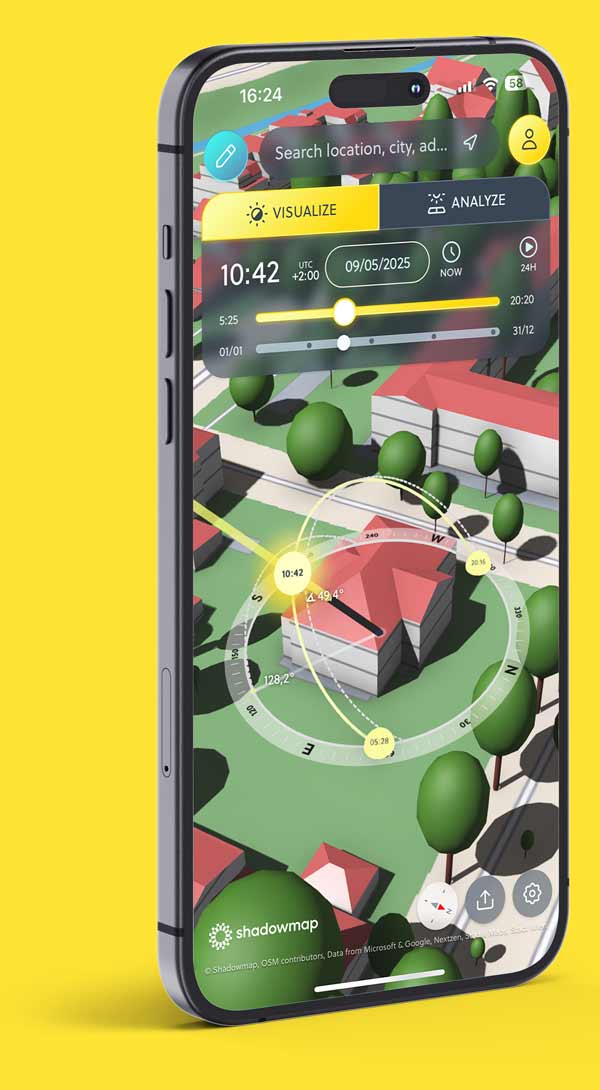
Shadowmap’s solar analytics tool complements Sunscore by providing granular, property-level solar potential assessments — enabling developers, homeowners, and energy investors to make data-driven decisions about the viability of solar installations and expected yields.
The Total Market Opportunity
Combining the three value streams, the Sun’s annual economic contribution — once properly captured and priced — is estimated at $4.6–4.7 trillion, representing 4–5% of global GDP (based on 2023 global GDP of approximately $94 trillion).
This figure spans:
Health system savings from reduced chronic disease burden
Real estate value uplift from quantified sunlight access
Solar energy generation and avoided fossil fuel costs
Sunscore is the first product to make this value legible at the asset level. It does not create the value — the Sun does. Sunscore creates the instrument to measure, communicate, and transact on it.
Why Now
Three macro trends are converging to make Sunscore’s launch timely:
Energy security concerns are driving governments and households toward self-sufficiency in power generation, accelerating demand for granular solar analytics.
Healthcare cost pressures are forcing payers and policymakers to examine preventive and environmental determinants of health at the systems level.
The evolution of the real estate market is creating demand for more granular, evidence-based property data as buyers, lenders, and investors seek differentiated signals.
Sunscore is not a bet on whether sunlight matters. The science and economics are clear. It is a bet on the value of being the entity that quantifies it first — and on the network effects that follow from becoming the standard.
References
Redfin/Ipsos. (2026). U.S. Residents Prioritize Sunlight Over Home Size. https://www.redfin.com/news/sunlight-home-satisfaction-2026/
International Energy Agency (IEA). (2024). World Energy Outlook 2024. https://www.iea.org/reports/world-energy-outlook-2024
International Energy Agency (IEA). (2025). Global Energy Review 2025 — Electricity. https://www.iea.org/reports/global-energy-review-2025/electricity
World Bank / ESMAP. Global Solar Atlas. https://globalsolaratlas.info
National Institutes of Health (NIH). (2023). Time Spent Outdoors and Myopia Risk https://pubmed.ncbi.nlm.nih.gov/38010695/. NIH. (2024) https://pubmed.ncbi.nlm.nih.gov/38710180/. Vitamin D and Cancer Risk. [Note: verify whether figures in health table should cite WHO or NIH.]
SpringerLink. (2024). Circadian Rhythms and Metabolic Health. [Full citation to be confirmed.]
World Health Organisation (WHO). (2019). World Report on Vision. https://www.who.int/publications-detail-redirect/world-report-on-vision
International Diabetes Federation (IDF). (2024). Diabetes Atlas, 11th Edition. https://diabetesatlas.org
IRENA & ILO. (2024). Renewable Energy and Jobs: Annual Review 2024. https://www.irena.org/Publications/2024/Oct/Renewable-energy-and-jobs-Annual-review-2024
Partager cet article:

EN SAVOIR PLUS
Des idées lumineuses



Tel que vu sur