Share:

Solar Energy: Powering Homes, Businesses, and the World
Solar power offers an inexhaustible, clean energy resource with vast potential to meet the world’s electricity needs. Advances in photovoltaics now enable businesses and households to generate power from rooftop panels, whilst large-scale solar farms supply grids with carbon-free electricity.
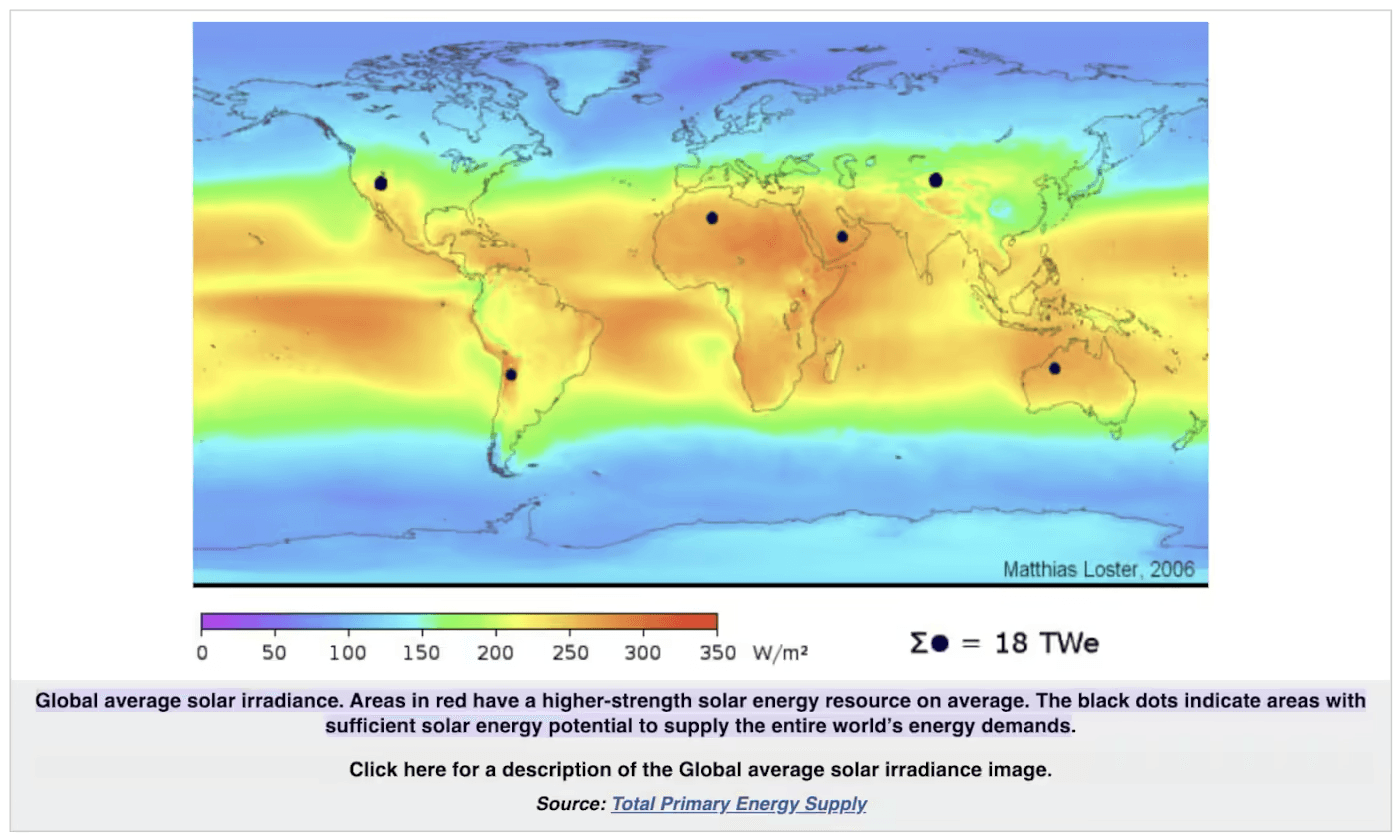
This visualisation highlights the Sun’s tremendous capacity as an energy source.
Indeed, solar is one of the fastest-growing energy sources globally, rapidly becoming a cornerstone of the clean energy transition. Consider the following points that underscore the sheer scale and feasibility of solar energy:
Enormous Energy Supply: The Sun delivers approximately 3.8 million exajoules of energy to Earth each year—equivalent to about 120,000 terawatt-hours (TWh). For context, global energy consumption in 2023 was around 620 exajoules (IEA, 2024). This means more energy reaches the planet in roughly 90 minutes than humanity uses in an entire year. Even a small fraction of this sunlight, if harnessed, could power human activities many times over.
Vast Generation Potential: Studies estimate that the technical potential of solar energy ranges from 1,500 to 50,000 exajoules per year, depending on land use and technology efficiency (World Bank, 2023). Even the lower end of this range is over twice the world’s current total energy consumption, whilst the higher end is over 80 times greater. In other words, solar could readily meet global demand if fully deployed.
Minimal Land Footprint: Solar’s abundance is such that covering only about 0.3-0.5% of Earth’s land area with solar panels (approximately 450,000-750,000 km², roughly the size of Spain or Thailand) could supply all our power needs (IEA, 2024). Suitable sites include deserts, rooftops, and degraded lands, minimising competition with agriculture. However, challenges such as land acquisition, grid integration, and the environmental impact of panel production must be addressed through innovations like battery storage and recycling programmes.
Growing Real-World Adoption: Thanks to plummeting costs (down over 80% since 2010), solar panels are increasingly installed on residential rooftops and commercial buildings, reducing energy bills and enabling owners to sell excess power back to the grid. Utility-scale solar farms are expanding as well. Consequently, solar PV generation increased by 23% in 2024, now providing 6.1% of global electricity, a share set to surge further in the coming years (IEA, 2025). This growth reduces reliance on fossil fuels, enhances energy security, and creates green jobs (e.g., 3.5 million solar jobs globally in 2023).
Bottom Line: Solar energy is affordable, abundant, and sustainable. The International Energy Agency highlights that developing solar technology brings “huge long-term benefits”: enhancing energy security (by tapping an indigenous, endless resource), reducing pollution, and helping tackle climate change. However, scaling solar requires overcoming barriers like energy storage and grid upgrades, which can be addressed through investments in smart grids and public-private partnerships.
Health Benefits of Sunlight: Preventing Chronic Diseases
Beyond energy, sunlight provides value through health benefits. Moderate exposure to sunlight (whilst avoiding burns) triggers our skin to produce vitamin D and helps regulate our circadian rhythms, both crucial for well-being. By leveraging these natural effects, society can prevent or alleviate several modern chronic diseases, leading to lower medical costs and a healthier, more productive population. Here are a few key health benefits of sensible time in the sun:
Reduced Myopia (Short-Sightedness) in Children: Children who spend 2–3 hours daily outdoors in daylight are 20–30% less likely to develop myopia (NIH, 2023). Bright natural light helps the developing eye maintain proper shape and focus. In parts of East Asia, where intense schooling keeps children indoors, myopia rates have reached 80–90%, prompting public health programmes encouraging outdoor play. Reducing myopia decreases dependence on glasses and lowers risks of serious eye complications like retinal detachment.
Lower Risk of Certain Cancers: Sensible sun exposure helps the body synthesise vitamin D, linked to a 20–40% reduced risk of colorectal, breast, and prostate cancers (NIH, 2024). For instance, a 2022 study found women with higher vitamin D levels had a 25% lower incidence of colorectal cancer. Excessive sun exposure increases skin cancer risk, so moderation (e.g., 10–30 minutes of midday sun, depending on skin type and latitude) is essential.
Improved Metabolic Health and Diabetes Prevention: Sunlight regulates circadian rhythms, improving insulin sensitivity and blood sugar control. A 2023 trial showed type 2 diabetes patients exposed to natural daylight had better glucose regulation than those under artificial light (SpringerLink, 2024). Vitamin D from sunlight also enhances insulin function; low levels are linked to a 30–50% higher risk of type 2 diabetes (NIH, 2023). Encouraging outdoor activity and safe sunlight exposure is a promising strategy to curb the diabetes epidemic.
Bottom Line: Safe sunlight exposure reduces chronic disease burdens, improving quality of life and economic outcomes. Public health campaigns should promote 10–30 minutes of daily sunlight (adjusted for skin type and region) and address risks like UV overexposure through education on sunscreen and timing.

Rethinking Buildings: Innovations in Glass and Lighting
To maximise the Sun’s potential, buildings must be reimagined to integrate advanced glass and lighting technologies that enhance solar energy capture and health benefits. Innovations in building design can amplify the economic and societal impacts of sunlight whilst improving energy efficiency and occupant well-being:
Smart Glass for Energy and Health: Modern glass technologies, such as photovoltaic (PV) glass and electrochromic glass, transform windows into dual-purpose systems. PV glass generates electricity directly from sunlight, with transparent solar panels producing up to 50 watts per square metre (NREL, 2024). For a mid-sized office building with 1,000 m² of windows, this could generate 50 kW, offsetting 10–20% of energy needs. Electrochromic glass, which adjusts tint based on sunlight intensity, reduces cooling costs by up to 20% whilst allowing controlled natural light to enter, supporting circadian health and reducing myopia risk in children (DOE, 2023). These technologies could save £70–140 billion annually if adopted globally in commercial and residential buildings.
Circadian-Optimised Lighting: Artificial lighting systems that mimic natural sunlight’s spectrum and intensity can enhance indoor health when outdoor exposure is limited. Circadian lighting adjusts colour temperature throughout the day (e.g., blue-rich light in the morning, warmer tones at night), improving sleep quality and metabolic health. A 2023 study found such systems reduced workplace fatigue by 15% and improved productivity by 5% (Journal of Building Engineering, 2024). Retrofitting 10% of global office spaces with circadian lighting could yield £35–50 billion annually in productivity gains.
Challenges and Opportunities: High upfront costs for smart glass (e.g., £350/m² for PV glass) and circadian lighting systems pose barriers, but prices are falling (down 30% since 2020). Policy incentives, such as tax credits or building regulation mandates, can accelerate adoption. Additionally, integrating these technologies with rooftop solar and energy-efficient designs can create net-zero buildings, further amplifying economic and health benefits.
Bottom Line: Rethinking buildings with innovative glass and lighting technologies enhances solar energy capture and promotes occupant health, contributing to both energy security and reduced healthcare costs. Governments and developers should prioritise these innovations in new constructions and retrofits.

Economic Impact: Quantifying the Sun’s Potential
The Sun’s potential for power generation, health benefits, and building innovations translates into substantial economic value. By harnessing solar energy and promoting safe sunlight exposure, societies can unlock significant financial benefits:
Solar Energy Value: If solar energy were scaled to meet global electricity demand (29,000 TWh in 2023), it could generate £3.0 trillion annually at current market prices (£0.10/kWh) (IEA, 2024). Additionally, scaling solar to supply 50% of global electricity could create 5 million new jobs, adding £175 billion annually in wages (IRENA, 2024). Combined with savings from reduced fossil fuel use and climate damages, solar’s economic contribution could reach £3.2 trillion annually.
Health Cost Savings: Safe sunlight exposure can reduce chronic disease prevalence:
Myopia: A 20–30% reduction in myopia prevalence through outdoor time could save £28–42 billion annually in productivity and vision care costs (WHO, 2019).
Cancer: A 20–40% reduction in colorectal, breast, and prostate cancer risks could save £35–70 billion annually in healthcare costs (WHO, 2024).
Diabetes: A 10–15% reduction in type 2 diabetes prevalence could save £70–105 billion annually in treatment and productivity losses (IDF, 2024).
Total Health Savings: These measures could yield £133–217 billion annually in savings, with additional benefits from improved mental health and circadian rhythm regulation.
Building Innovations: Adopting smart glass and circadian lighting globally could save £70–140 billion in energy costs and add £35–50 billion in productivity gains annually, further enhancing the Sun’s economic impact.
Total Economic Potential: Combining solar energy, health benefits, and building innovations, the Sun could unlock £3.4–3.5 trillion annually, equivalent to 4–5% of global GDP (£73 trillion in 2023). Achieving this requires investments in solar infrastructure (e.g., £350 billion annually through 2030) and public health and building design initiatives.
Conclusion and Call to Action
The Sun offers multifaceted benefits: an abundant energy source to power economies, a natural health resource to reduce chronic diseases, and an opportunity to rethink buildings for efficiency and well-being.
Governments can invest in solar infrastructure, offer subsidies for rooftop panels and smart glass, and streamline permitting for solar farms.
Public health campaigns should promote 10–30 minutes of daily sunlight exposure through school programmes, workplace wellness initiatives, and community guidelines.
Developers should prioritise PV glass, circadian lighting, and net-zero designs in new constructions and retrofits. By embracing these strategies, societies can achieve cleaner energy, lower healthcare costs, and a healthier, more productive population.
References
International Energy Agency (IEA). (2024). World Energy Outlook 2024.
National Institutes of Health (NIH). (2023). Time Spent Outdoors and Myopia Risk.
National Institutes of Health (NIH). (2024). Vitamin D and Cancer Risk.
SpringerLink. (2024). Circadian Rhythms and Metabolic Health.
World Health Organization (WHO). (2019). Global Vision Health Report.
International Diabetes Federation (IDF). (2024). Diabetes Atlas.
International Renewable Energy Agency (IRENA). (2024). Renewable Energy and Jobs.
National Renewable Energy Laboratory (NREL). (2024). Photovoltaic Glass Technologies.
U.S. Department of Energy (DOE). (2023). Electrochromic Glass Energy Savings.
Journal of Building Engineering. (2024). Impact of Circadian Lighting on Workplace Productivity.
Share this article:

AS Seen On