Share:
SUNLIGHT MATTERS · SPECIAL FEATURE
How the global ban on incandescent bulbs became one of the great unexamined decisions of the modern age — and why almost nobody is allowed to say so.
A conversation with Anna, journalist and author of Incandescent and Dark Skies
“I think we possibly had it — and an incandescent light used sparingly with a dimmer switch is not the environmental demon it’s been described as.”
A Strange Story Crashes In
Anna didn’t set out to become a light writer. A freelance journalist and editor who had spent decades covering wildlife and natural history, she was deep in the world of otters and marine mammals when something unexpected upended everything. “This strange story of light crashed into my life,” she says. “Suddenly I was working on European legislation and physics and all sorts of subjects that felt way out of my depth.”
What followed was a years-long investigation that would eventually become her book, Incandescent, a work that begins with her own body reacting to a new generation of light bulbs and spirals outward to encompass politics, physics, ecology, and what she calls “the deep sea and the sky.” It became, she says, “about everything.”
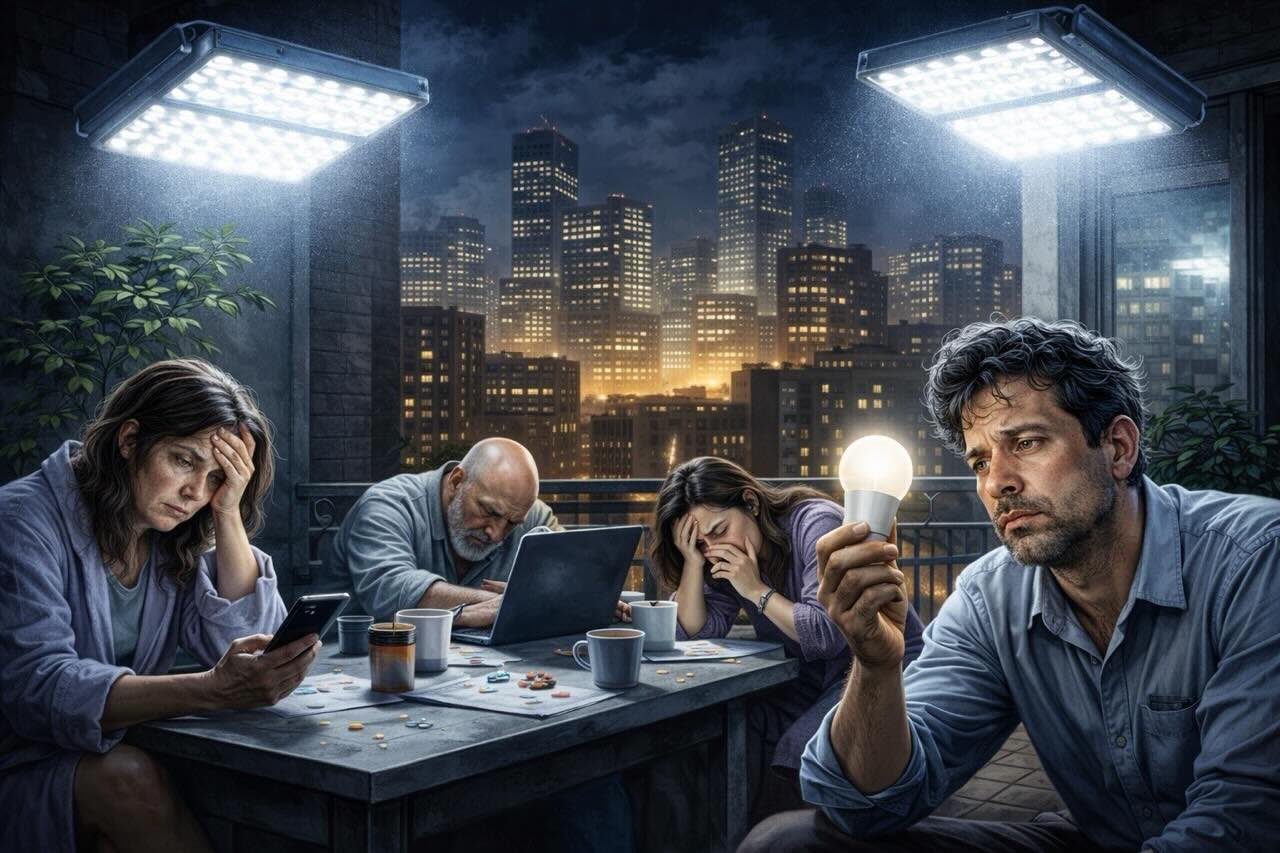
The problems began with CFL bulbs; the curly fluorescent lights that swept through homes and workplaces in the early 2000s as part of the global push toward “low energy” lighting. Anna started feeling ill in places that had them. “I felt weird, just things I’ve never felt before. Like my head was swelling up. I got dizzy and disorientated and I couldn’t speak or process my thoughts properly.” Doctors initially dismissed the idea that a light bulb could be responsible. But the more questions she asked, the more she found a picture nobody seemed to be joining together.
“There were physicists working on light, and medics working on human bodies — neurologists, dermatologists, psychologists,” she says. “But nobody seemed to be joining the dots. And the people making regulations were lumping lights in with kettles and toasters as just an appliance.”
The Ban That Went Around the World
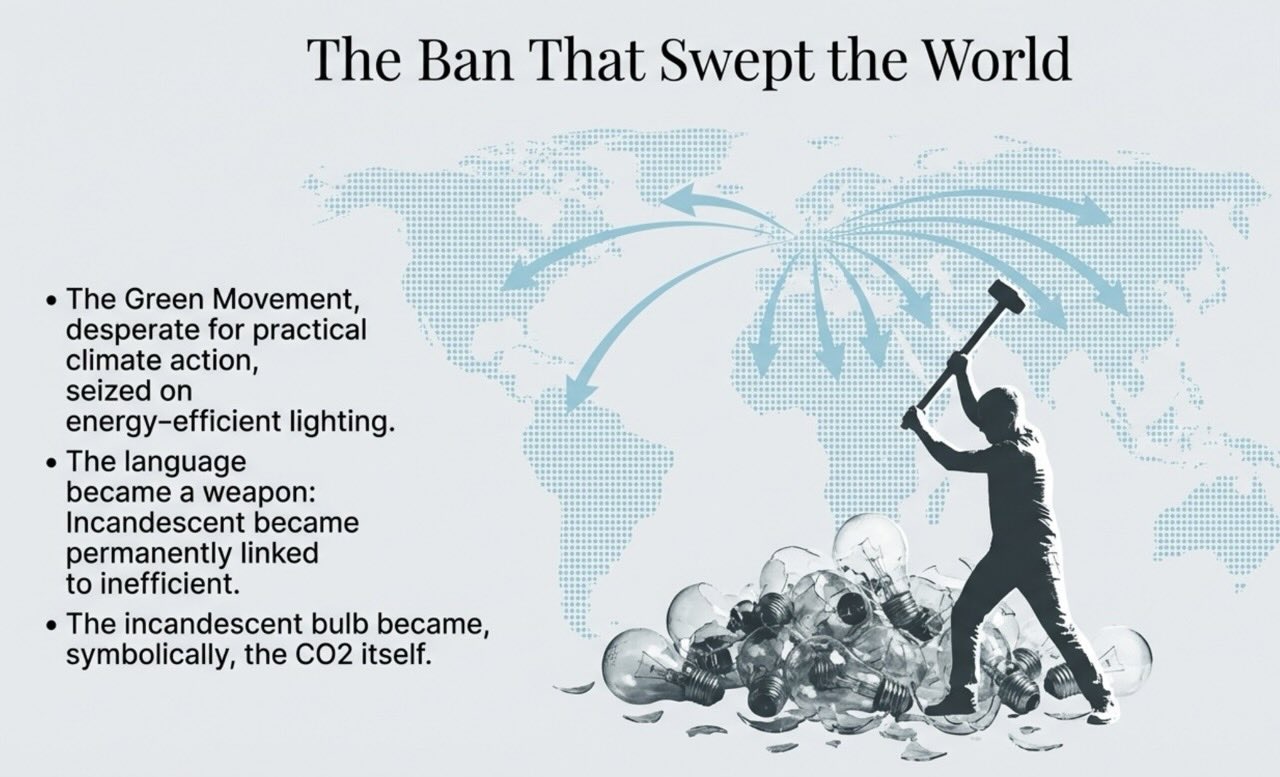
The phasing out of incandescent light bulbs was a remarkable phenomenon; a regulatory shift that swept the globe with extraordinary speed, driven largely by good intentions. The Green Movement, desperate for practical action on climate change, seized on energy-efficient lighting as something tangible people could do. The logic seemed bulletproof: measure the lumens per watt at the point of use, compare old bulbs unfavourably to new ones, and legislate accordingly.
The problem, Anna argues, is everything that measurement left out. “It didn’t look at the materials, the manufacturing, the transportation, the recycling. There was no environmental risk assessment, no human health risk assessment, and no understanding of the effect of that quality of light on human life or the environment. We took one tiny measure and made global regulation about it.”
At the time, leading dermatologists and ophthalmologists warned against the ban, describing incandescent lighting as “biologically harmonious.” Their concerns went largely unheeded. CFLs, which contained mercury and brought their own environmental problems, became the mandated alternative.
Then came something else: language. “Every time you said the word incandescent, you said inefficient. Inefficient, incandescent, inefficient, incandescent. And they talked about incandescent light bulbs going extinct as if this was some natural process. But actually it was a political decision.” In Germany, Greenpeace smashed 10,000 incandescent bulbs in a demonstration, calling them too dangerously inefficient to use. The bulb had become, symbolically, the CO2 itself.
“Consensus has a sort of texture — a gloopy, sticky stuff. You can punch a hole in it and it fills in again. You can have something that isn’t true, but build and build on it, so that even if you remove the foundation, it doesn’t move.”
The Ideology Trap
What happened next is where Anna’s story gets genuinely strange. When she started challenging the consensus, in environmental circles, among green-minded friends, she met not curiosity but something closer to revulsion. “When I talked about otters or dolphins, people leaned forward with a sparkle in their eyes. When I talked about light bulbs, I got this repulsion.”
She came to understand why. People had changed their light bulbs. They had been green. To question that act was to threaten something deeper than a consumer choice. But there was also something more structural at play. The debate had become ideologically contaminated.
“It became: Donald Trump doesn’t want incandescent light bulbs banned. I don’t want incandescent light bulbs banned. Therefore, I’m in the same camp.” In the UK, it was tangled up with Brexit, not wanting Brussels to tell people what to buy. In the US, it merged with arguments about government overreach. On both sides of the Atlantic, a question of physics and human health had become a culture-war proxy.
The result is a kind of taboo. Even people who are now starting to see the problems with LED lighting are reluctant to suggest that incandescents might simply have been better. “Nobody’s saying what it achieved, because it’s too big a thing to say: we really cocked up there. That was a big mistake.”
What Light Actually Does to Us
Part of what makes this story so difficult to tell, Anna says, is that light itself is profoundly underestimated. We think of health in terms of diet, sleep, exercise, and stress. Light barely registers. Yet the body’s relationship with light is ancient, deep, and total.
“Light and dark has been the constant. The beat that everything on Earth has evolved to live with. In a very short space of time we’ve utterly messed with that.” Every system in the human body is circadian. Light affects blood sugar, cell renewal, the immune system, mood, and cognitive capacity. It does this not just through the eyes but through the skin, through mechanisms science is still uncovering.
To prepare for her book, Anna took physics lessons with a Cambridge academic. Two things emerged that permanently changed her thinking. First: light is irreducibly complex. “You cannot reduce it to lumens per watt. Any measurement you take, you’re missing something else.” Second: at the deepest level, light is still a mystery. The wave-particle descriptions are metaphors. Scientists at the frontier of physics are working with analogies, not facts. “Up till that moment, I thought scientists knew stuff and artists did the metaphors. And then I realised we are all just trying to find ways of understanding.”
Now there is growing scientific evidence about what is absent from LED light — not just what is present. The concern about blue light has given way to deeper questions about the wavelengths that simply aren’t there. “We’re starting to understand the effects of what isn’t there, the emissions of light. It just comes back to the question: what are we trying to achieve?”
More Light, Not Less
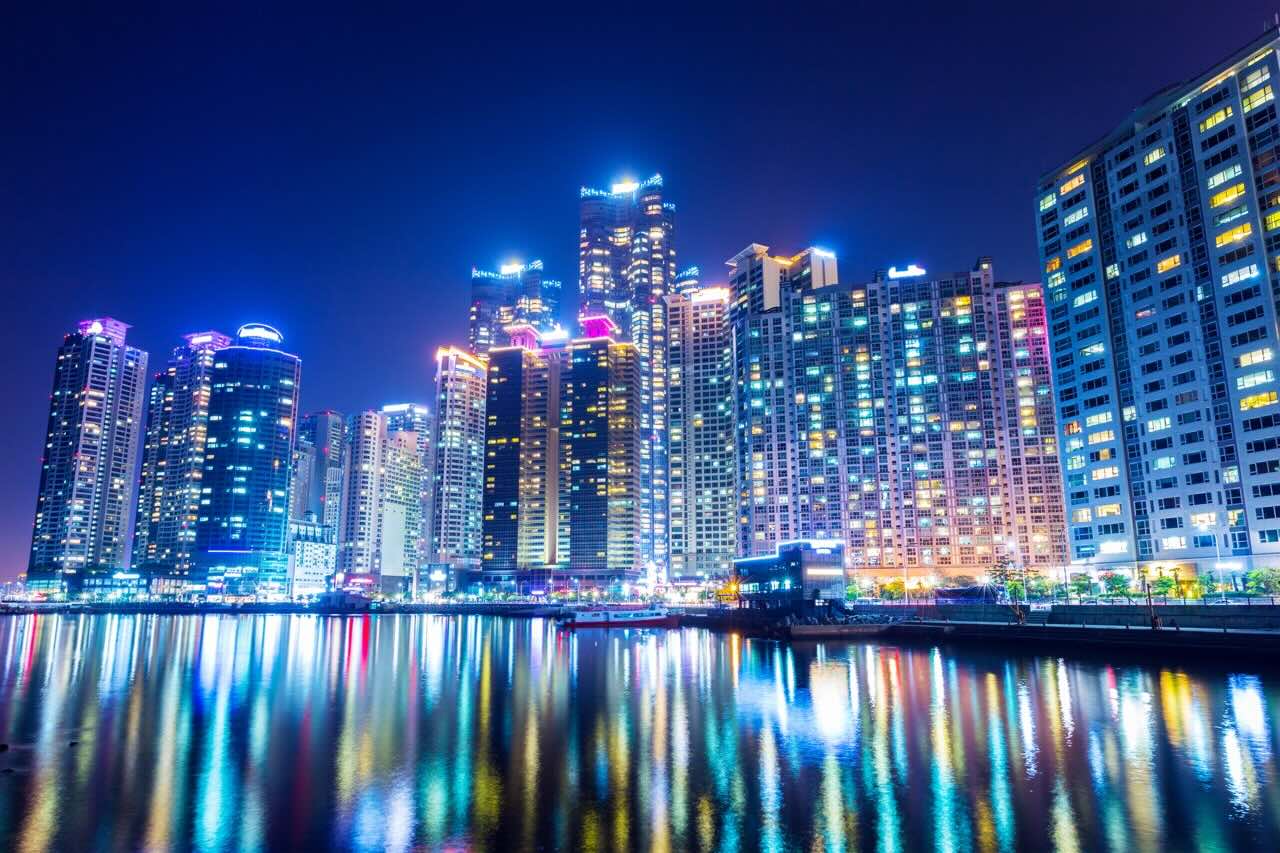
There is a bitter irony at the heart of the low-energy lighting story. One of the main drivers of the ban was energy consumption. But in switching to cheap, “efficient” LEDs, we have simply used more light. Cities have grown brighter. Screens have multiplied. Outdoor lighting has proliferated. The Sphere in Las Vegas, a structure of almost unimaginable LED density, is an extreme expression of a general truth.
“We banned incandescent light bulbs, which I might use in a little bedside lamp to read before bed. But there’s no restriction on energy used to light half a city with 20,000 Christmas LEDs. It doesn’t make sense.” A lighting designer in the US found that, at the time, the same energy savings could have been achieved simply by using dimmer switches and turning lights off. Instead, the opposite happened.
And light pollution, the flooding of the natural world with artificial light at night, is now one of the most significant and least-discussed environmental harms of the age. It disrupts every species that has evolved around the rhythm of dark and light: bats, insects, birds, fish, trees. It washes out the night sky. And increasingly, scientists are connecting it to effects on human health that go far beyond sleep disruption.
“I look across to Stirling from my house at night and it’s dazzlingly bright. That is the environmental crime. Not an incandescent light bulb in my bedside lamp.”
The People Who Can’t Tolerate the World
For most people, the problems with modern lighting are a matter of comfort and wellbeing; headaches at work, discomfort in shops, a vague sense of something not being right. These are real, and Anna argues we are “bizarrely tolerant of shite lights” in a way we would never accept with bad smells or irritating noise.
But for a significant and largely invisible group of people, the situation is far more serious. People with lupus, autism, certain neurological conditions, and others with severe light sensitivity are finding public life increasingly inaccessible. Public transport, medical appointments, education, and shopping are all increasingly lit with bright LED systems that some people simply cannot tolerate.
At the time of the ban, politicians across the spectrum promised that incandescent bulbs would remain available for those who needed them. Those promises were not kept. The charity LightAware fought successfully to have the right to incandescent lighting written into European and subsequently UK legislation. But there is still no mechanism for a person to obtain them through a doctor or pharmacist. “Once we can’t get them online anymore, I don’t know how people are going to light their homes.”

Listen to Your Body
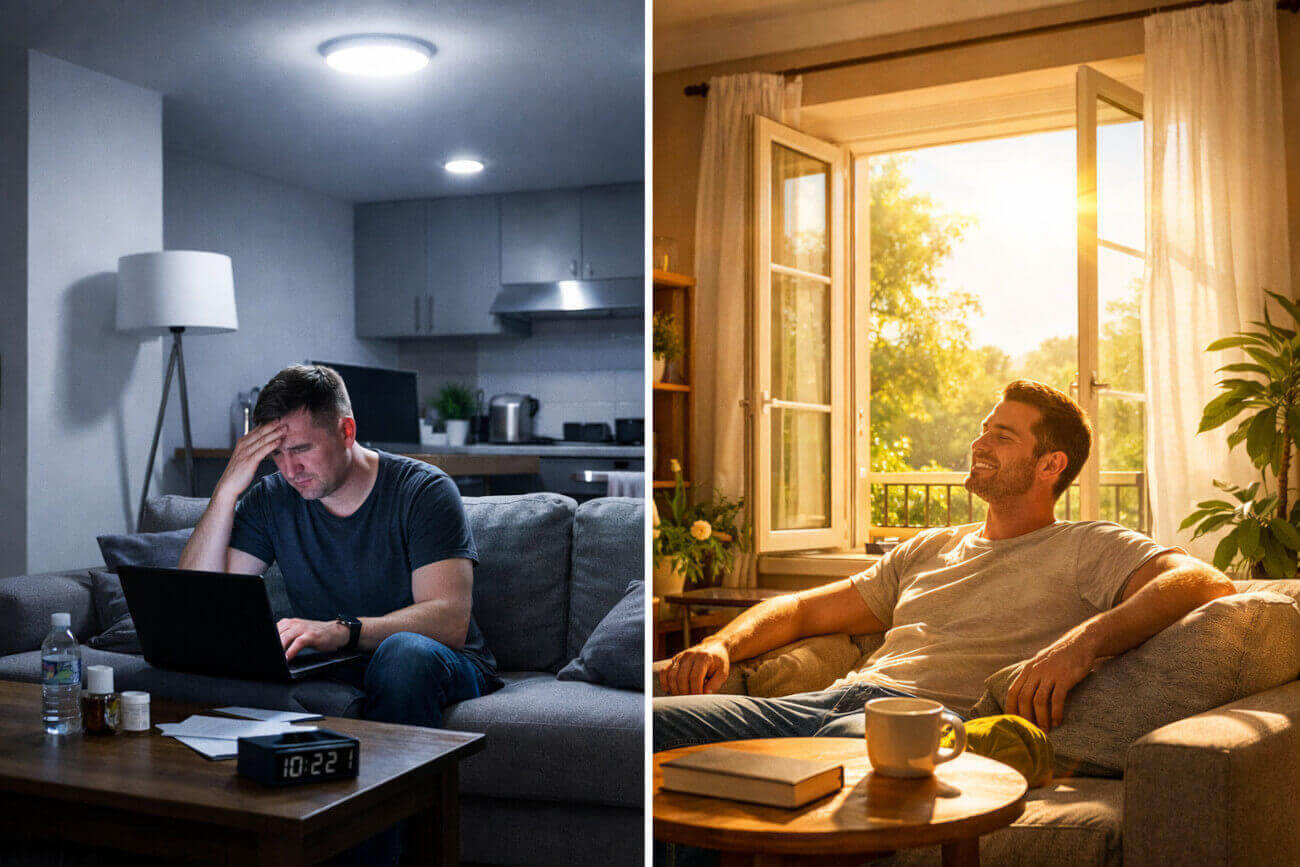
Anna’s broader message is not one of despair. It is one of attentiveness. People already know, at some level, when light is right and when it isn’t. The pleasure of candlelight at a restaurant, the ease of a room with good natural light, the discomfort of a harshly lit office — these are real signals from a body that has been calibrated by millions of years of evolution.
“We do have an amazing gadget that’s been in nature’s R&D for millions of years. That’s our own body and mind. You know when the light isn’t right. And you also know when it is.”
The same attentiveness applies to darkness; a resource Anna argues is as important as light itself. Her second book, Dark Skies, is a celebration of what darkness gives us: not just rest, but wonder. The experience of the night sky, the Milky Way, and the aurora. The capacity to feel small and awed by something vast. “There’s a generation growing up in cities that have never seen the night sky. Psychologists talk about an awe deficit - a lack of the wonder you get from contemplating something bigger than yourself.”
Starting Again
What would Anna like to see happen? Not a simple reversal. Though she believes incandescent lighting deserves serious reexamination. What she’s calling for is something more fundamental: a willingness to start again with better questions.
“We need to look at light in the context of everything we now know about the environment, about light pollution, about every aspect of human psychology and physiology. And then say: what light is best for what circumstances? When we look at the total environmental impact; manufacturing, recycling, everything, we may well find we’re better off with what we had. But nobody’s saying that, because it’s become a taboo word.”
The law of unforeseen consequences, as Anna puts it, is one of the most important laws there is. It’s a law that applies to pesticides washing into rivers and wiping out otters. It applies to screens and bulbs and the flooding of the night. And it applies whenever the technology races ahead of the research, and the consensus closes in before the questions have been properly asked.
“It’s technology racing ahead of research and understanding. It’s not some natural process. It’s not evolution. We made a decision. And we can make better ones.”
Anna is the author of Incandescent (2024) and Dark Skies. She is a co-founder of the charity LightAware. This article is adapted from a conversation recorded for the Sunlight Matters podcast.
If this article has sparked your curiosity, explore Anna Levin’s powerful books on light, darkness, and our evolving relationship with illumination:
🌞 Incandescent: We Need to Talk About Light
A deeply personal and investigative journey into the global phase-out of incandescent lighting — and what it means for health, environment, and policy.
👉 https://saraband.net/sb-title/incandescent/
🌌 Dark Skies: A Journey into the Night
An exploration of light pollution, the loss of the night sky, and why darkness is essential for both human and ecological wellbeing.
👉 https://saraband.net/sb-title/dark-skies/
Share this article:

LEARN MORE
Illuminating insights

AS Seen On